
Maritime Insights · Operations
Stop Re-Typing Vessel Transactions. Import the PDF Instead.
400 transactions a month. By hand. From PDFs.
That is the math for a crewing manager running a 10-vessel fleet. Twenty Cash Advance entries per vessel. Twenty Crew Slop Chest Deduction entries per vessel. Multiply by 10 and you are looking at 400 line items every single month, all of them arriving as PDF reports from vessels and all of them needing to land correctly in payroll.
Most operators we talk to handle this the same way. The PDF arrives by email. Someone opens it on one screen, opens the accounting or payroll system on the other, and starts re-typing. Crew name. Amount. Currency. Date. Transaction type. Forty rows per vessel. Every month.
When it goes wrong, it goes wrong quietly. A digit transposed in a Cash Advance amount. A Slop Chest deduction applied to the wrong rotation. A currency conversion that nobody double-checked. The error does not surface until the seafarer signs off, looks at the payslip, and asks why the numbers do not match what the captain told them. Now you are doing reconciliation under pressure with a crew member who is already unhappy.
This is not a process problem. It is a system problem.
Why manual entry survives in maritime longer than anywhere else
In most industries, manual data entry from PDF reports disappeared a decade ago. In maritime crewing, it persisted for a specific reason. The PDF reports come from vessels, in formats that vary by master, by software on board, and by the level of attention the chief officer paid that month. There was no standard, so there was no automation, so the only reliable way to get data off the page and into payroll was a person and a keyboard.
That is the problem RiteCrew solved.
How import works in RiteCrew
You upload the vessel's PDF report. RiteCrew parses it. Each line item appears as a structured transaction in the import-transactions queue with its crew member, type, amount, currency, and date pre-filled. You review them on screen. You confirm or correct. You post them to payroll.
Forty rows per vessel becomes one upload, one review pass, and one click. Across a 10-vessel fleet, what used to take a full day of typing now takes the time it takes to read through the parsed records and confirm them.
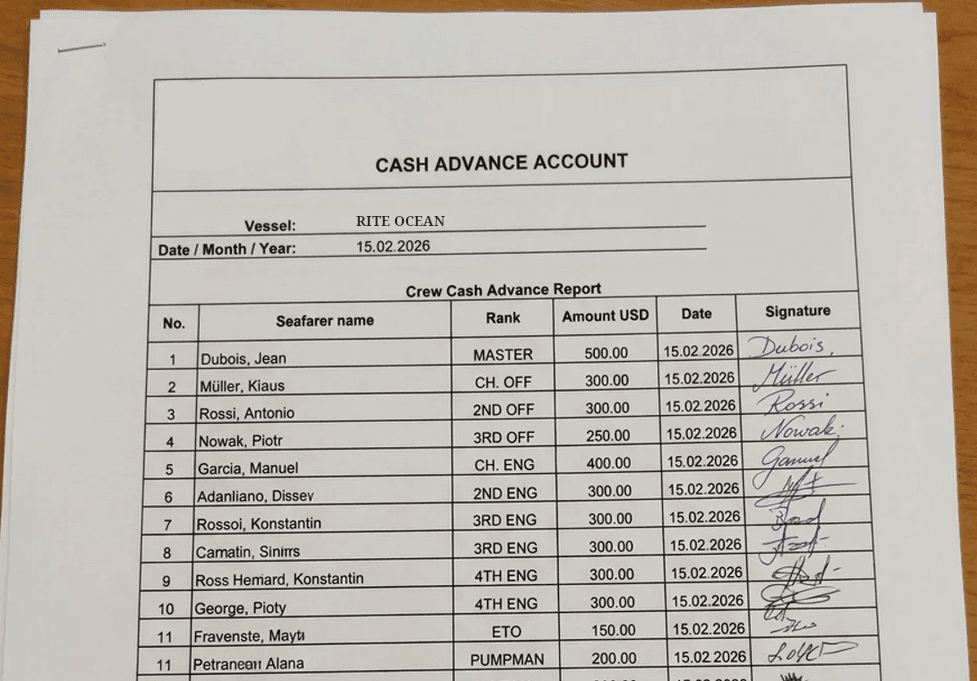
The parsed records are not floating in a separate import system. Every imported transaction is linked back to the seafarer record, the contract, and the payroll cycle it belongs to. If a crew member queries an amount on their payslip, you can trace it from the payslip line, to the contract, to the imported transaction, to the original PDF, in three clicks. That is what auditable means in practice.
What 400 transactions a month actually costs
Run the math on the manual workflow.
If a competent administrator can enter and verify a vessel transaction in 90 seconds (and that is a generous estimate once you account for cross-checking against the PDF), 400 transactions take 600 minutes. That is 10 hours of administrator time every month spent on data entry that adds zero operational value. At a typical loaded administrator cost across Europe, you are spending €300 to €450 per month, or €3,600 to €5,400 per year, paying someone to re-type information that already exists in a structured format on the vessel's report.
That is before you count the cost of the errors that manual entry inevitably produces, the time spent investigating disputed payslips, and the credibility cost of every wrong number a seafarer sees on their payslip.
Cash Advances and Slop Chest are just the start
The same import flow handles every recurring vessel transaction type. Cash Advances. Slop Chest Deductions. Bond purchases. Onboard expenses. Wage adjustments confirmed by the master. Anything that arrives as a PDF from the vessel becomes structured data in RiteCrew without re-typing.
For operators running 5 to 30 vessels, this is one of the highest-leverage automations in the platform. It is also one of the easiest to validate. We will show you the imported records side by side with the source document, in a 20-minute demo.
The point is not the parser
The point is that crew administration in 2026 should not require anyone to retype a number that already exists in a digital report. The PDF is structured. The destination is structured. The work in between is what software is for.
If your team is still running the manual loop on vessel transactions, we would like to show you what 400 transactions a month looks like when the system handles them.
See it in action
Book a 20-minute demo and we will show you the imported records side by side with the source PDF. Or take the platform tour to see RiteCrew end-to-end first.