
Maritime Insights · Recruitment
The Seafarer Application Portal: From Paper CVs to a Clean Online File
Maritime hiring still runs on email attachments and WhatsApp.
Most crewing teams we talk to receive CVs the same way: a PDF in an inbox, a passport scan over WhatsApp, a STCW certificate forwarded twice, a follow-up message asking for the medical that was supposed to be in the first email. By the time a recruiter has assembled a complete file, they have touched the same candidate's documents in four different places and re-typed the contact details into the CRM by hand.
RiteCrew Apply is the front door we built so that stops happening. One submission. One verified file. One click for the recruiter to bring the applicant into the CRM.
What recruiters actually need from an application
When we sat with the recruiting teams of the fleets we manage, the same complaint came back every time. The bottleneck is not finding candidates. The bottleneck is getting a complete, verified file from a candidate who is already interested. The minimum bar for a recruiter to evaluate a seafarer looks like this:
- Identity verified - legal name, date of birth, passport scan.
- Contact channels verified - both email and phone, not just one.
- Professional history - rank applied for, total months at sea, vessel-by-vessel sea-service records.
- Documents - CV, STCW, medical, references, flag-state endorsements.
In the email-and-WhatsApp model, putting that list together for a single candidate takes days of back-and-forth and produces a file the recruiter has to manually re-assemble in the CRM. In RiteCrew Apply, the applicant assembles it themselves, in one session, on their phone.
How the portal works
The applicant lands on a passwordless sign-in. They enter an email or phone, receive a 6-digit code, and they are in. No account creation form. No password reset emails. The same OTP flow handles returning applicants who want to pick up where they left off.
Once inside, they see a single dashboard with a submission checklist. Profile basics. Rank. CV. Email verified. Phone verified. Sea-service history. Certificates. Every item is either complete, in progress, or not started, and the Submit button stays disabled until every required item is green.
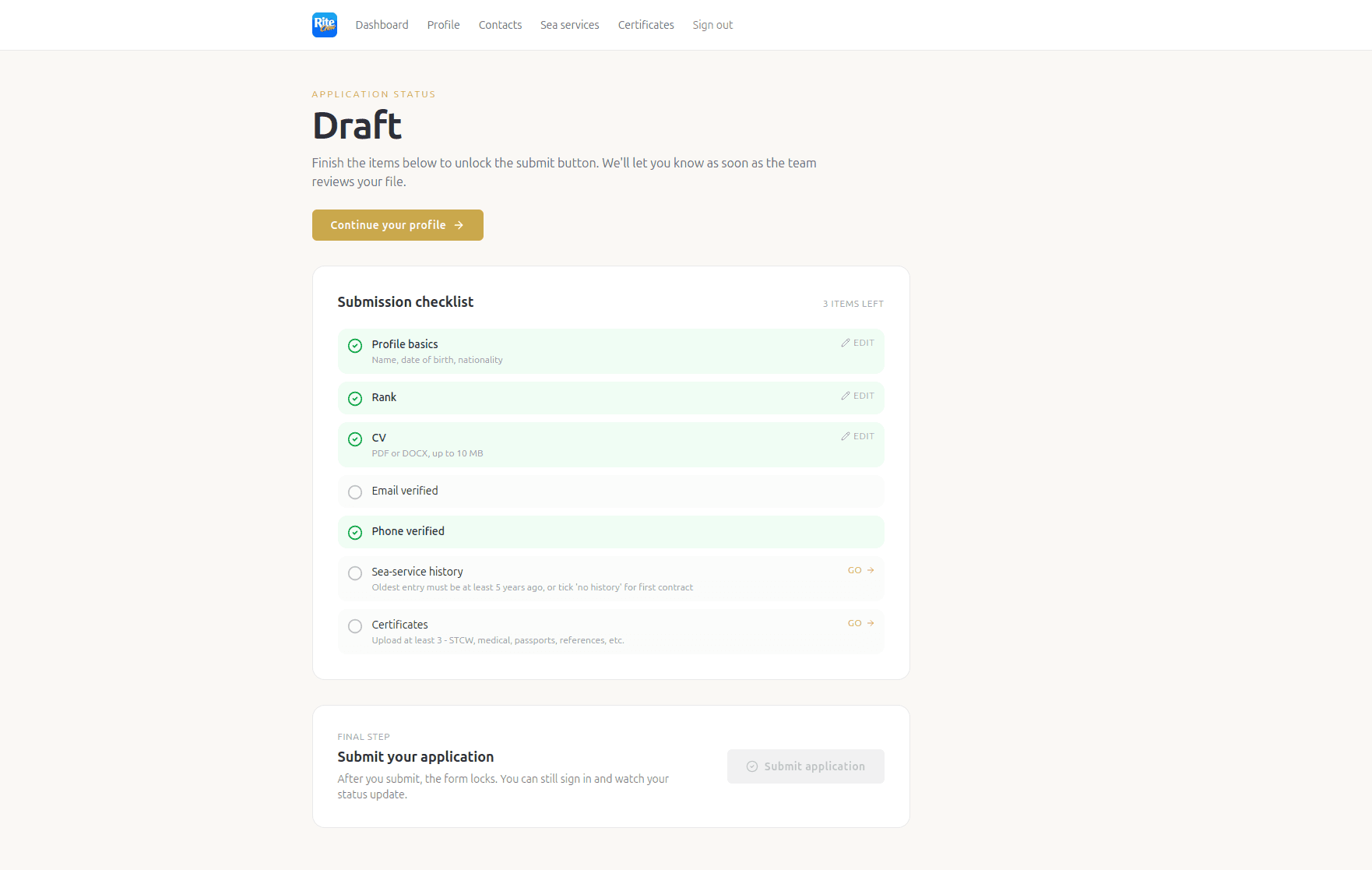
The checklist is not cosmetic. It is the submission gate. An applicant cannot send a half-baked file to a recruiter and expect a chase email back. They finish the file, or it does not get submitted. That single design decision changes the economics of the recruiter's day: they spend their time evaluating complete files instead of chasing missing documents.
Why passwordless, why both channels
Passwords are a hiring funnel killer. The applicant who hits a password reset email at 11pm from a ship in a different timezone gives up. The applicant who is asked to remember a portal password they set six months ago gives up. RiteCrew Apply removes that surface entirely - sign-in is the same OTP flow every time, on any device.
The other deliberate choice is verifying both email and phone. Recruiters need email for the status updates and document trail. They need phone for the time-critical contact when a candidate is on a short rotation window or already at sea. Either alone is not enough. Both are confirmed by OTP before the application can be submitted, so the contact details that land in the CRM are not theoretical - they are verified working channels.
What the recruiter sees on the other end
When the applicant submits, the file enters the recruiter review queue inside RiteCrew CRM - the same CRM that runs vessel schedules, rotations, and payroll for the rest of the fleet. There is no export, no re-keying, no separate database. Approval is one click, and the candidate becomes a seafarer record ready for vessel assignment.
Every state change - submitted, accepted, rejected, deleted - is recorded in an audit log with the actor and timestamp. If a candidate later disputes a rejection, or a regulator asks how a particular person ended up on a particular vessel, the answer is in the log.
Data residency and trust
Applicants are uploading passports, medicals, and CVs. That comes with a duty of care. RiteCrew Apply stores every document encrypted at rest on AWS infrastructure in the European Union (Frankfurt / Ireland), with daily encrypted backups and GDPR-compliant retention. Applicants can request deletion at any time and we remove the file, documents, and account within 30 days.
Access is scoped per applicant. An applicant can only see their own files. A recruiter can only see files for applications they are authorised to review. We do not sell, share, or train AI models on applicant data. The file stays in the EU, on encrypted infrastructure, accessible only to approved RiteCrew recruiters until the applicant asks us to delete it.
What it changes for an operator
For the operators running fleets with us, the portal changes three things measurably:
- Time-to-evaluate drops. Recruiters open a complete file on day one instead of spending three days assembling it from email threads.
- Re-keying disappears. Approved applicants flow straight into the CRM. There is no second-system data entry, no transcription error.
- Audit is built-in. Every status change is logged with actor and timestamp. Internal reviews and flag-state queries answer themselves.
The point is not the form
Any vendor can build a web form. The point of RiteCrew Apply is that the form is wired into the system that runs the fleet on the other side. The submission gate, the verified channels, the audit log, and the one-click CRM import all exist because the same team that designed the portal also operates the crewing back office it feeds.
Hiring at sea should not require chasing scans over WhatsApp in 2026. If your team is still running the manual loop, we would like to show you what one submission, one verified file, and one click to the CRM look like together.
See it in action
Read the full portal overview or book a 20-minute demo and we will walk you through a real applicant journey end-to-end.